Why microinverters beat string inverters for commercial
Traditional string inverter systems tie every panel on a circuit together, meaning one shaded, soiled, or underperforming panel drags down the entire string. For large commercial rooftops and ground-mount arrays where partial shading, equipment shadows, or varied panel orientations are unavoidable, that's a significant production loss hiding in plain sight.
Enphase IQ9 and IQ8 microinverters take a fundamentally different approach: each panel gets its own dedicated inverter mounted directly on the module. Power conversion happens at the panel level, so every module operates at its individual maximum power point regardless of what the panels around it are doing.
Key advantages for commercial deployments include:
- No single point of failure. If one microinverter fails, the other hundreds keep producing. There is no central inverter whose failure takes the whole system offline.
- Superior shade tolerance. Partial shading of even a section of the array has minimal impact on overall production because affected modules are isolated from the rest.
- Module-level monitoring. Enphase Enlighten shows real-time performance data for every individual panel, making it straightforward to pinpoint a failing module, debris accumulation, or wiring issue, no site visit required.
- Simplified design flexibility. Multiple roof faces, mixed orientations, and complex footprints that would require multiple string inverter groupings can be handled cleanly with a microinverter layout.
Furman University case study
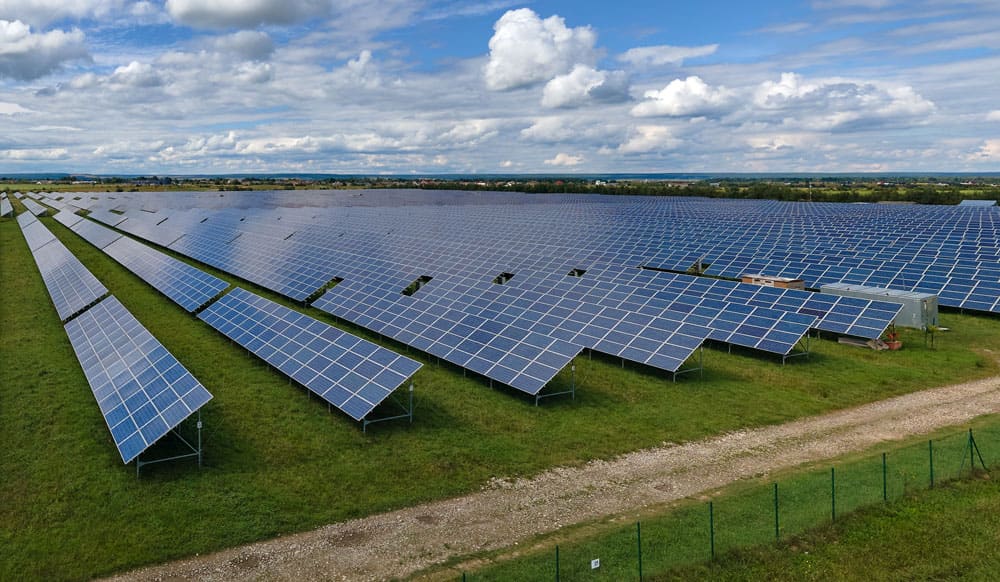
Detail Solar provides ongoing maintenance for Furman University's 988kW ground-mount system and led its upgrade to Enphase IQ9 microinverters, a showcase example of what that architecture can do at commercial scale. The system covers a large open ground-mount array delivering three-phase power directly to the university's electrical infrastructure, right here in our home service area of Greenville, SC.
Ground-mount arrays at this scale present unique engineering challenges: string inverter solutions typically require combiner boxes, long DC home-run runs with associated voltage drop and arc-flash risk, and multiple large inverter skids. The Enphase architecture eliminates the high-voltage DC runs entirely: each microinverter outputs AC at the panel, so cabling to the aggregation point carries only AC power.
The Furman upgrade also satisfies the project's Buy America Act requirements (see below), making it eligible for federal incentives applicable to institutional projects. The combination of production performance, simplified DC safety, and procurement compliance made IQ9 the right fit for a university institution with both a long investment horizon and specific federal contracting obligations.
Technical specs
Enphase IQ9 microinverters are purpose-built for commercial and utility-scale deployments. Key specifications that matter to commercial buyers:
- 97.5% CEC weighted efficiency: among the highest in the microinverter category, minimizing conversion losses at every panel.
- 0.05% field failure rate: Enphase's reliability data across millions of deployed units. For a 988kW system with roughly 2,200+ microinverters, that's statistically fewer than two unit replacements over the system's lifetime.
- Manufacturer warranty: the equipment carries the manufacturer's warranty, which is among the strongest in the inverter category and eliminates the mid-life inverter replacement cost that string inverter systems carry.
- Native 480V 3-phase output: IQ9 commercial microinverters output directly to three-phase 480V grids, the standard for commercial and industrial utility connections, without additional step-up transformers.
Buy America Act compliance
The Buy America Act (BAA) requires that iron, steel, manufactured products, and construction materials used in federally funded infrastructure projects be produced in the United States. For solar projects receiving federal funding, or installed at institutions that receive federal grants, BAA compliance is a procurement prerequisite, not just a preference.
Enphase microinverters are manufactured in the United States, allowing projects using them to satisfy BAA requirements. This opens Enphase-based systems to a wide range of institutional buyers (universities, K-12 school districts, municipal utilities, federal agencies, and government contractors) that are legally required to source compliant equipment.
For Detail Solar, this means the same high-performance microinverter solution we deploy for commercial customers also unlocks procurement eligibility for institutional and government projects that might otherwise be closed to imported equipment. It is one reason Furman University could move forward with the IQ9 upgrade under its procurement guidelines.
Ready to bring Enphase to your commercial project?
Interested in Enphase IQ9 or IQ8 microinverters for your commercial installation? Contact Detail Solar to discuss your project's size, grid connection requirements, and whether a microinverter architecture is the right fit.
Contact Detail Solar